
Think about the best meal you’ve ever had. You probably remember one great moment, like the first bite or the dessert, instead of two hours of steady “pretty good.” That pattern is the peak-end rule, one of the most relatable ideas in behavioral economics. When we look back on an experience, we don’t average out every moment. We judge it mostly by two points: the most intense moment (the peak, good or bad) and how it ended.
Psychologist Daniel Kahneman and his collaborators found that how long an experience lasts actually has little effect on how we remember it, which they named the duration neglect. Kahneman frames it as a split between two selves. The experiencing self feels things moment to moment. The remembering self writes the review and decides what to do next time. The remembering self is in charge, even though it’s a pretty unreliable record keeper.
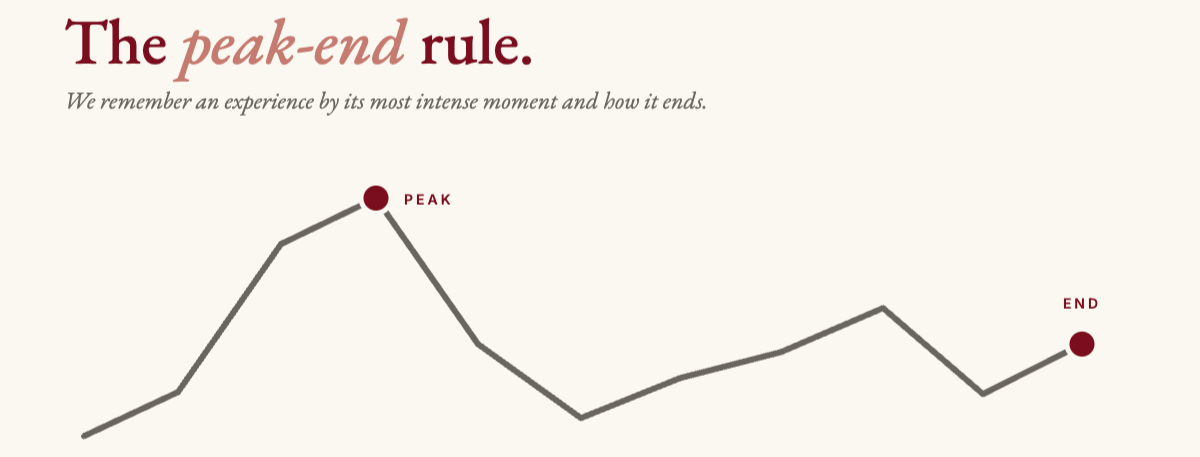
The classic evidence is a cold-water experiment. Participants held one hand in painfully cold water for 60 seconds. They held the other hand in the water for 60 seconds, then kept it there 30 seconds longer while it warmed slightly to a still-painful temperature. When asked which trial to repeat, a significant majority chose the longer one. The longer trial had more total pain, but it ended better. In 1996, Donald Redelmeier and Kahneman had patients rate their pain in real time during colonoscopies and lithotripsy, then evaluate the experience afterward. Their overall memories tracked the worst moments and the final moments, not how long the procedure took. A 2003 randomized trial tested this in the real world. In a group of 682 colonoscopy patients, half had a short interval added to the end of the procedure while the scope stayed still. Those patients felt the final moments as less painful and were slightly more likely to come back for another colonoscopy over about five years of follow-up.
You can see this everywhere. A brutal final or disappointing grade can change how you remember a class you liked the whole semester, and a great last lecture or A+ can rescue a mediocre class. Restaurants hand out a free dessert or a mint at the end because a good finish covers a so-so meal. At theme parks you remember the best ride and the major drops, not the ninety-minute lines. A bad breakup can rewrite how you remember an entire relationship, and a great last interaction with a support rep can flip a bad customer experience. Even workouts and study sessions are easier to come back to if they end on something that feels good.
A few questions are worth chewing on. If the remembering self makes our future decisions, should we care more about how experiences feel or how we’ll remember them? Which one are we optimizing for in college? Is it manipulative when businesses design the end of an experience on purpose, or is that just good service? And how could you use this on yourself to make something boring but necessary end on a high note?
The takeaway is that our memories are highlight reels, not full recordings. If you’re designing anything for people, whether that’s an event, a survey, or a focus group, how it ends matters more than you’d think.
Works Cited
Fredrickson, Barbara L., and Daniel Kahneman. “Duration Neglect in Retrospective Evaluations of Affective Episodes.” Journal of Personality and Social Psychology, vol. 65, no. 1, 1993, pp. 45–55.
Kahneman, Daniel, et al. “When More Pain Is Preferred to Less: Adding a Better End.” Psychological Science, vol. 4, no. 6, 1993, pp. 401–05.
Redelmeier, Donald A., and Daniel Kahneman. “Patients’ Memories of Painful Medical Treatments: Real-Time and Retrospective Evaluations of Two Minimally Invasive Procedures.” Pain, vol. 66, no. 1, 1996, pp. 3–8.
Redelmeier, Donald A., et al. “Memories of Colonoscopy: A Randomized Trial.” Pain, vol. 104, no. 1–2, 2003, pp. 187–94, https://doi.org/10.1016/S0304-3959(03)00003-4.
